
Third-party assurance report and accounting process

Coca-Cola Bottlers Japan Holdings Inc. has obtained third-party assurance for some environmental and social data to ensure the reliability of the disclosed figures.
★: Covered by third-party assurance for FY 2025.
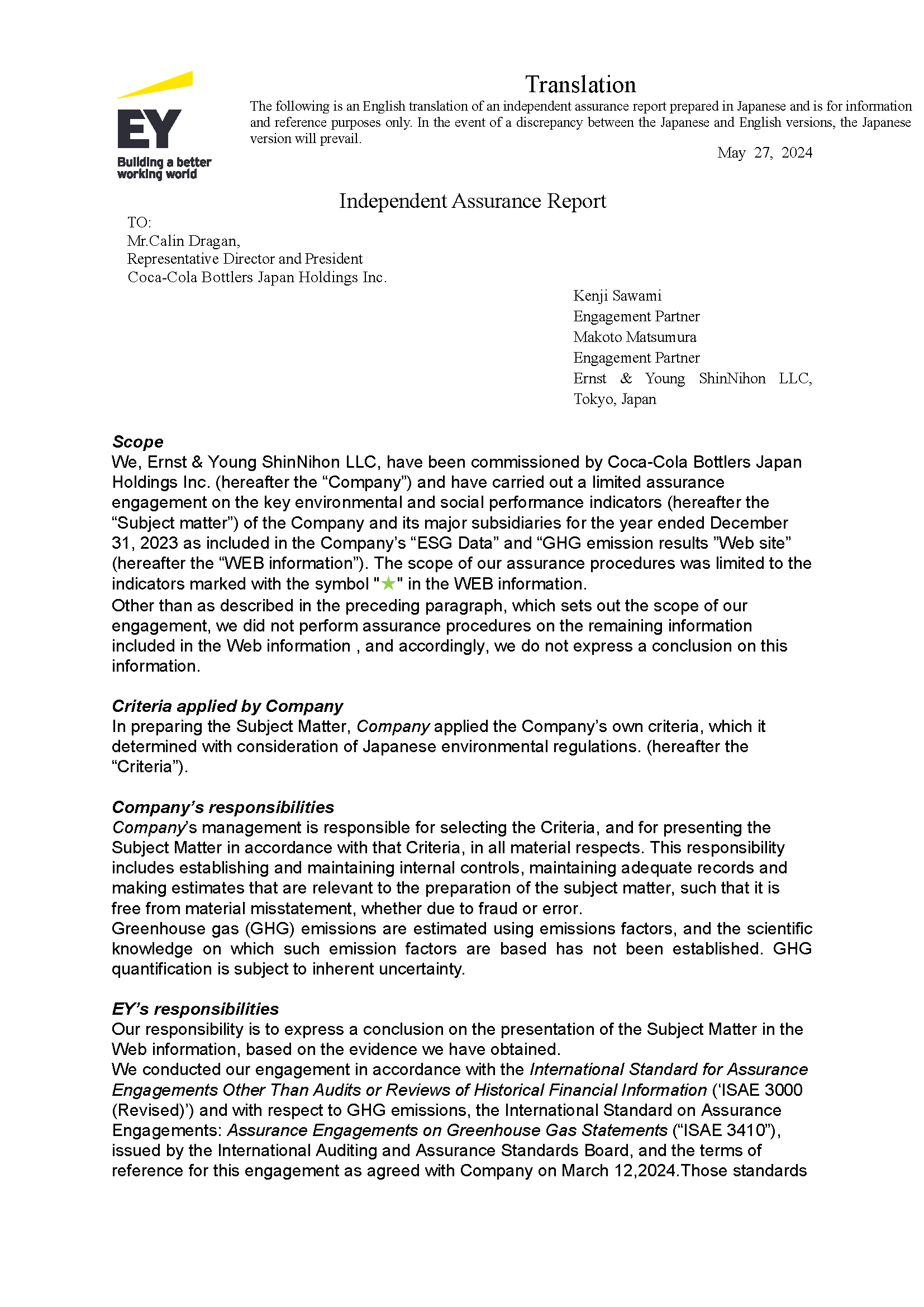
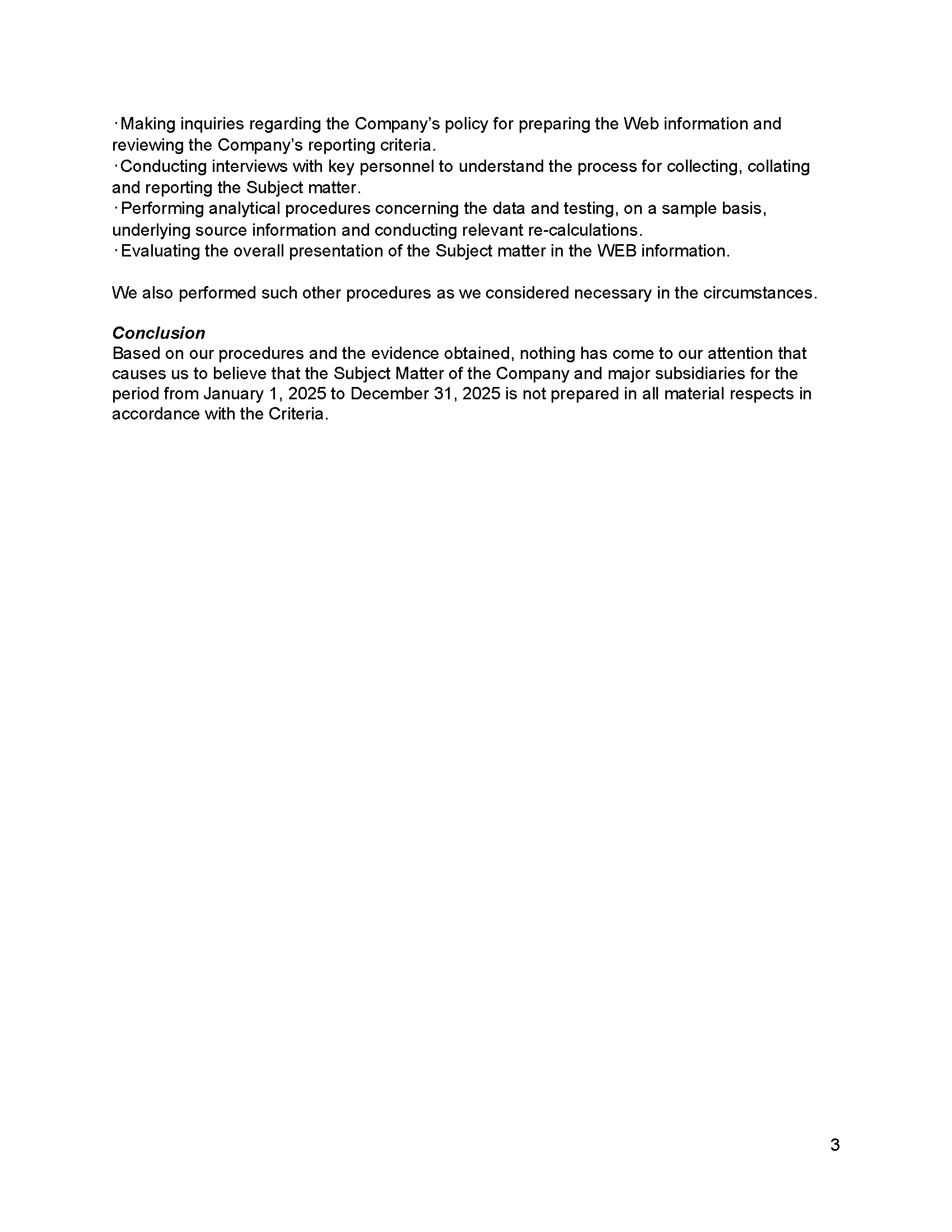
Third-party assurance report

Accounting process
Environment
| Calculation scope | Accounting method | |
|---|---|---|
| Water | CCBJH Group *1 |
・Tap water = Total usage of invoices from the Water Departmen ・Groundwater = Total of metered water ・River = Total of metered water ・Sewage: = Total usage of invoices from the Sewerage Department ・Water consumption = Calculated by subtracting the discharge volume from the intake volume |
| Manufacturing | CCBJH Group's 17 manufacturing plants. |
・Total energy use (GJ) = total of (energy use for each energy type × thermal conversion factor *2) ・Greenhouse gas (CO₂) emissions (thousand t-CO₂e) = total of (energy use for each energy type × CO₂ emission factor) |
| Logistics | Logistics related to the Group's business from the CCBJH Group's 17 manufacturing plants to the market (customer stores and vending machines, etc.). Also includes third-party (outsourced) transportation. |
・Total energy use (GJ) = total of (energy use for each energy type × thermal conversion factor) ・Greenhouse gas (CO₂) emissions (thousand t-CO₂e) = total of (energy use for each energy type × CO₂ emission factor) |
| Offices | Buildings related to the CCBJH Group's business operations (head office, sales centers, distribution centers, and plant-associated facilities, etc.). |
・Total energy use (GJ)= total of (energy use for each energy type × thermal conversion factor) ・Greenhouse gas (GHG) emissions (thousand t-CO₂e) = total of (energy use for each energy type × CO₂ emission factor), and the amount of fluorocarbons leakage (CO₂ equivalent) based on Fluorocarbon Emissions Control Act |
| Sales | CCBJH Group Assets(vending machines, coolers, dispensers) operating in the Company's sales areas (excluding leased assets). |
・Total energy use (GJ) = annual sales equipment electricity use × thermal conversion factor ・Greenhouse gas (CO₂) emissions (thousand t-CO₂e) = annual sales equipment electricity use × CO₂ emission factor |
- *1 The CCBJH Group refers to Coca-Cola Bottlers Japan Holdings Co., Ltd. and all 11 of its consolidated subsidiaries.
- *2 Sources for thermal conversion factor and CO₂ emission factor
・CO₂ emission factors are based on the “Emission Factors by Electric Power Company” published by the Ministry of the Environment and the Ministry of Economy, Trade and Industry (January–March 2025: FY2023 results [published in March 2025]; April–December 2025: FY2024 results [published in February 2026]).
・For manufacturing and office operations, adjusted emission factors based on electricity provider plans are applied; for other sectors, default values are used (Jan–Mar: 0.422 kg-CO₂/kWh; Apr–Dec: 0.416 kg-CO₂/kWh).
・Regarding the thermal conversion factor for electricity, the thermal conversion factor of 3.6 MJ/kWh for electrical energy use specified in the Guide to the Energy Conservation Law (Factories and Business Premises Edition)—Revised Edition, FY 2023—shall be applied.
・Source: “Heat Content Conversion Factors for City Gas: ‘Emission Factors by Gas Supplier (for Calculating Greenhouse Gas Emissions by Specified Emitters) – FY2024 Supply Data – Published by the Ministry of the Environment and the Ministry of Economy, Trade and Industry on June 30, 2025’”
・The calorific value conversion factors and CO₂ emission factors for fuels other than those listed above are cited from the “Manual for Calculating and Reporting Greenhouse Gas Emissions (Ver. 6.1)” (Ministry of the Environment and Ministry of Economy, Trade and Industry, March 2026).
・For vending machines, emissions are calculated based on region-specific emission factors (national average factors) as a general rule, by multiplying the annual electricity consumption per machine by the number of machines in operation during the fiscal year. For vending machines that use non-fossil fuel certificates, site-specific emission factors are applied.
Social
| Calculation scope | Accounting method | |
|---|---|---|
| Employees | Percentage of female employees (CCBJH, CCBJI, CCCMC, CCBJV, FVJ, CCBJBS, NeoArc, CCBJB) *3 |
・Female employees ratio(%)= female employees ÷ number of all employees |
| Percentage of female managers (percentage of women in management positions) (CCBJH, CCBJI, CCCMC, CCBJV, FVJ, CCBJBS, NeoArc, CCBJB) *4 |
・Female managers ratio(%)= female managers ÷ number of all managers | |
| Occupational safety | LTIFR (Lost-Time Injury Frequency Rate) (All employees except 3PL by employment category) (CCBJH, CCBJI, CCCMC, CCBJV, FVJ, CCBJBS, NeoArc, CCBJB) |
・LTIFR = number of lost-time incidents ÷ total no. of working hours x 1,000,000 |
- *3 Excluding temporary staff
- *4 Excluding directors, temporary staff, rehired employees, partner employees, part-time employees and senior employees